Two thousand years, one small footprint
Bath has drawn visitors for over 2,000 years, built around the only naturally occurring hot springs in Britain and the Roman baths complex that still surrounds them. What makes it a genuine weekend city rather than a day trip is that almost everything else worth seeing was built centuries later, in one concentrated 18th-century building boom, on top of the same small footprint.
The Circus and the Royal Crescent: one family's vision, two generations
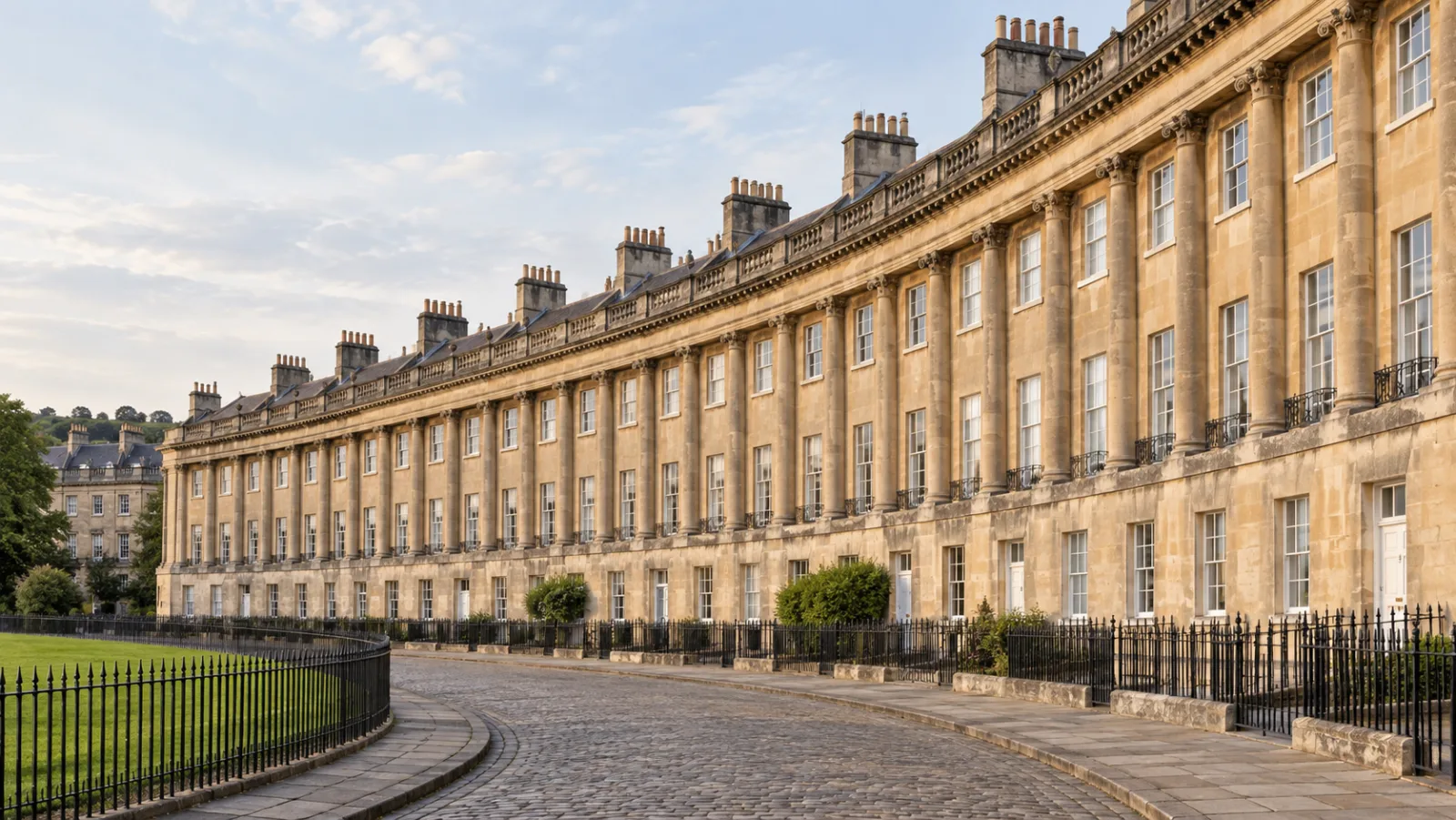
The Circus — three curved terraces arranged around a circular green — was designed by architect John Wood the Elder; his son, John Wood the Younger, went on to design the Royal Crescent nearby, a sweeping row of thirty terraced townhouses fronted by giant Ionic columns. Both are built from Bath Stone, the same warm local limestone used across the whole city, which is why the entire centre reads as a single unified composition rather than a collection of separate landmarks. The Circus has also picked up a lighter claim to fame as a former home to residents including Nicolas Cage and Johnny Depp.

Pulteney Bridge and the river
Pulteney Bridge, completed in 1774 to a design by the Scottish architect Robert Adam, crosses the River Avon lined with small shops built directly into the bridge structure itself — one of only a handful of bridges in the world built this way. It's a five-minute walk from the abbey and the Roman Baths, which is the whole point: in Bath, the next landmark is almost always a five-minute walk from the last one.
Why two nights, not one
A single day covers the Roman Baths and a walk past the Circus and Royal Crescent, but it doesn't leave time to actually sit somewhere — a café on Pulteney Bridge, the view from Alexandra Park over the rooftops, or a slower loop of the Georgian terraces beyond the obvious two. Two nights turns a checklist into an actual weekend; the city is compact enough that the second day doesn't need a plan at all.